Core Projects

01

ALIP
African Legal Intelligence Platform

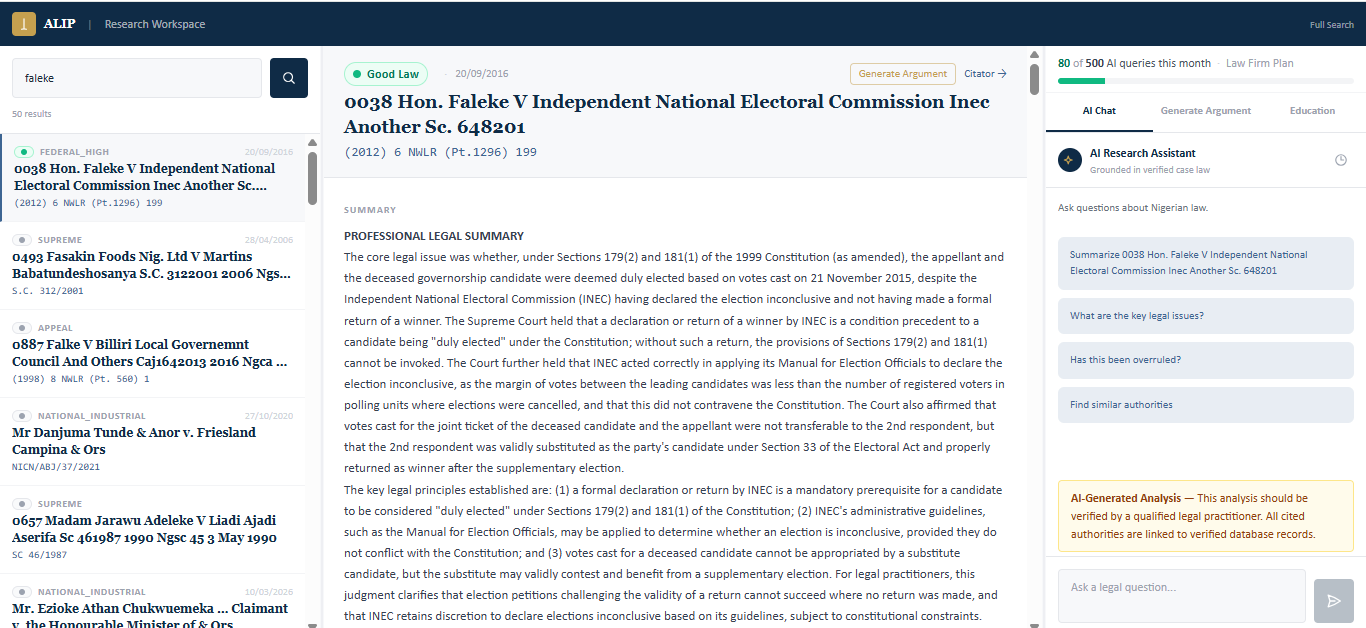
A live AI-powered legal research platform I designed and built for African jurisdictions, starting with Nigeria. I defined the full system architecture across ten FastAPI microservices, the retrieval and citation data model, and the AI grounding strategy, then directed implementation in Python, FastAPI, and Next.js, with the Claude API as the reasoning layer.

ALIP indexes case law, judgments, and statutes, and builds a citator with treatment badges and overruling detection across the citation graph. Case summaries are generated by Claude but grounded strictly in retrieved source text, so the system cannot invent or hallucinate a citation. Currently indexing over 2,100 cases and live in beta.

Role

System Designer · AI Director

Type

Legal Tech Platform

Backend

Python · FastAPI (10 microservices) · PostgreSQL

AI Layer

Claude API · RAG · Citation Grounding

Grounded Citation Check — no hallucinated authorities
def generate_case_summary(case: Case, retrieved_chunks: list[str]) -> str:
    # Only the retrieved source text is allowed as grounding context
    context = "\n\n".join(retrieved_chunks)

    prompt = (
        f"Summarise this case using only the context below. "
        f"Every citation you make must appear verbatim in the context.\n\n"
        f"Context:\n{context}"
    )
    summary = call_claude(prompt)

    # Reject the summary if it cites anything not present in the source
    if not citations_verified(summary, context):
        raise GroundingError("Summary contains an unverified citation")

    return summary
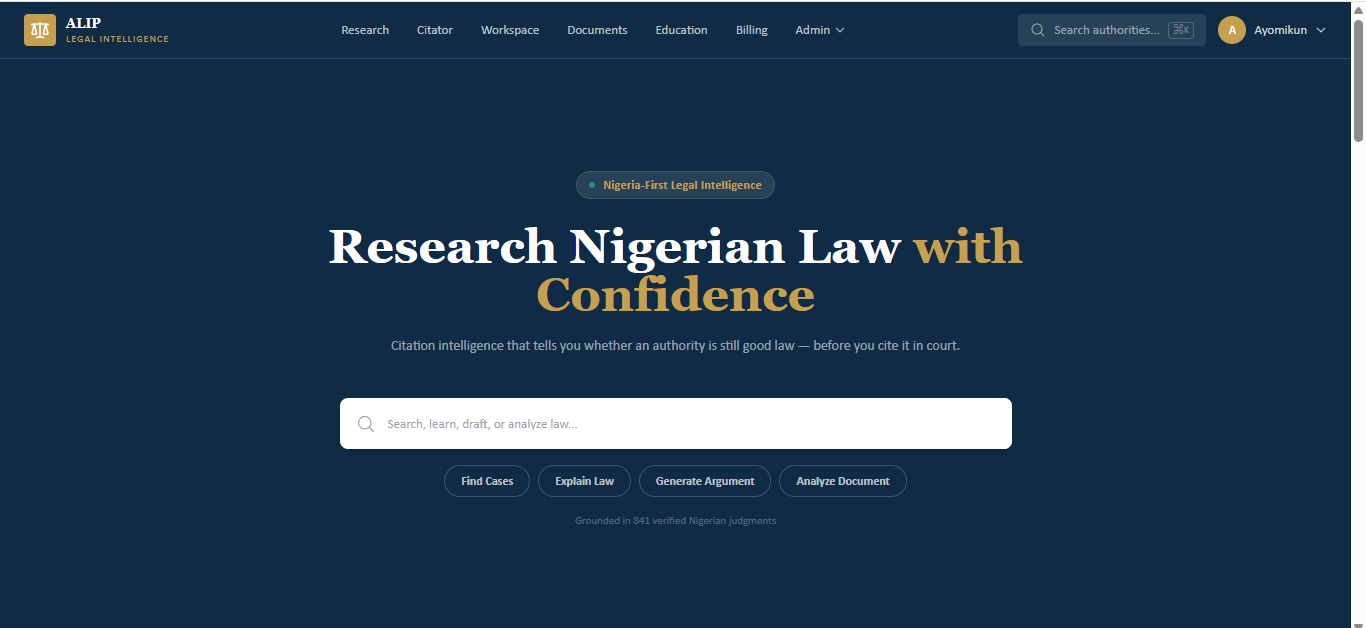
Live at alip.africa
ALIP research workspace showing AI-generated case summary grounded in source text
ALIP landing page at alip.africa

03

KingdomConnect
Enterprise Church Management System

A production-grade enterprise platform I designed and directed for multi-level church administration. I defined the full system architecture — the organisational hierarchy, data models, access control logic, and AI integration layer — then brought it to life using AI-assisted development in Python, FastAPI, and PostgreSQL.

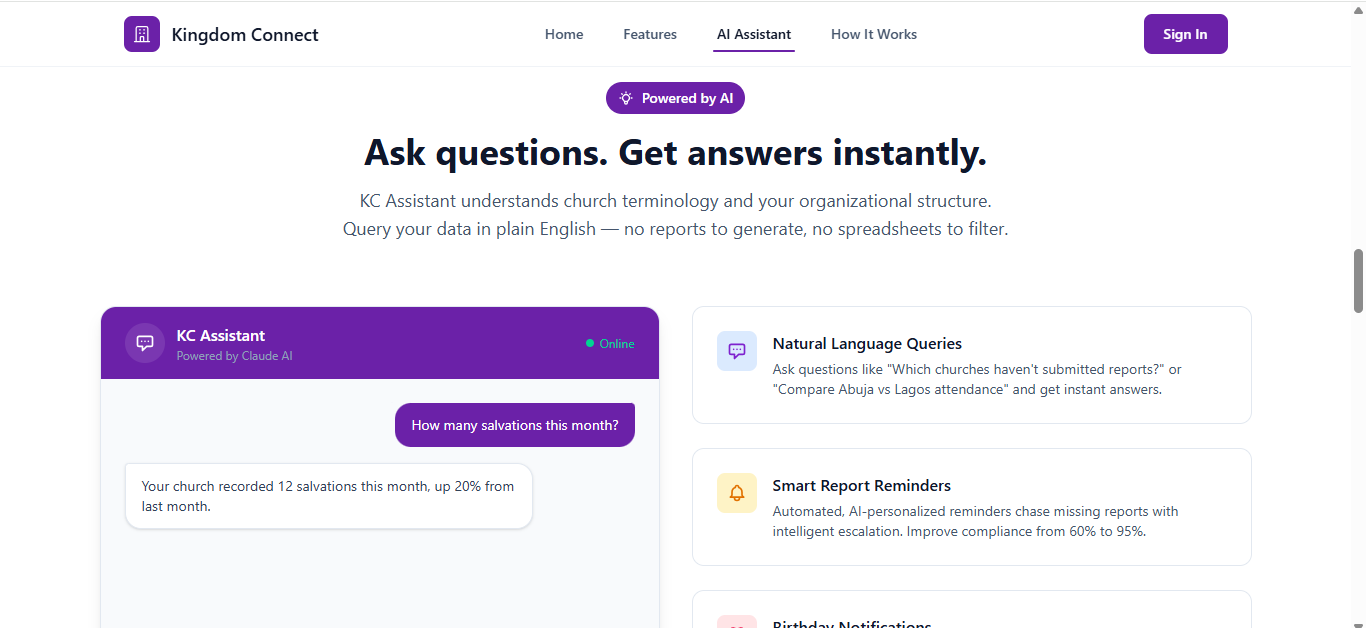
The platform covers membership management, service and event reporting, role-based access control with fine-grained permissions, and a Claude API-powered assistant for administrative queries. This project reflects how I work: strong system thinking and domain design, with AI as a development partner to ship complete, working software.

Role

System Designer · AI Director

Type

Enterprise Platform

Backend

Python · FastAPI · PostgreSQL

AI Layer

Claude API · LLM Integration

Role-Based Access Control — permission check
def check_permission(user: User, resource: str, action: str) -> bool:
    # Resolve role hierarchy: church → region → country → HQ
    role_chain = get_role_chain(user.role, user.scope_level)

    for role in role_chain:
        policy = PERMISSION_MATRIX.get(role, {})
        if action in policy.get(resource, []):
            return True

    raise PermissionDenied(
        f"Role '{user.role}' cannot '{action}' on '{resource}'"
    )
Private Repository
KingdomConnect AI Assistant interface

04

HopeBridge AI
RAG-Powered Resilience Support System

A context-aware support companion I designed for Nigerians aged 16 and above facing life challenges across 20 categories — from business failure and job loss to grief, domestic abuse, and mental health. The core design principle: the user must feel heard before they are helped.

I authored the full system design — the 4-layer conversation flow, the 3-level crisis detection logic (including Nigerian Pidgin signal phrases), the 20-category life challenge taxonomy, and the resource database structure. Implementation uses FAISS semantic retrieval, AI-assisted development in Python and FastAPI, and the Claude API for response generation.

Platforms

Web · Mobile · WhatsApp

Languages

English · Nigerian Pidgin

Retrieval

FAISS · sentence-transformers

AI Layer

Claude API · RAG Pipeline

3-Level Distress Detector — Pidgin-aware
CRISIS_SIGNALS = [
    "i want to end it all", "no reason to continue",
    "i wan just disappear", "make god just take me",
    "i don plan how i go do am",
]

AMBER_SIGNALS = [
    "i tire for this life", "wetin be the point",
    "nobody care if i dey here", "i don give up",
]

def classify_distress(message: str) -> DistressLevel:
    text = message.lower().strip()
    if any(sig in text for sig in CRISIS_SIGNALS):
        return DistressLevel.RED    # immediate crisis
    if any(sig in text for sig in AMBER_SIGNALS):
        return DistressLevel.AMBER  # check in deeper
    return DistressLevel.GREEN   # standard conversation
Private Repository
HopeBridge AI

05

RAG Chatbot System
Document-Aware AI Assistant

A document-aware AI assistant I designed and built using AI-assisted development. The system ingests enterprise documents, builds a semantic vector index, and generates accurate, grounded responses via the Claude API — for use cases where hallucination-free, source-backed answers are non-negotiable.

I designed the retrieval architecture — document ingestion pipeline, embedding strategy, configurable top-k retrieval — and directed the FastAPI backend implementation for clean integration with downstream services.

Role

AI Engineer · System Designer

Type

AI Backend Service

Backend

Python · FastAPI

Deployment

DigitalOcean

RAG Pipeline — retrieval & prompt assembly
def retrieve_and_respond(query: str, index: faiss.Index) -> str:
    # Embed the user query
    query_vec = embedder.encode([query])

    # Retrieve top-3 relevant document chunks
    _, indices = index.search(query_vec, k=3)
    context = "\n\n".join(doc_store[i] for i in indices[0])

    # Assemble grounded prompt for Claude
    prompt = (
        f"Answer using only the context below.\n\n"
        f"Context:\n{context}\n\n"
        f"Question: {query}"
    )
    return call_claude(prompt)
Private Repository
RAG Chatbot

06

VIN Decoder AI Engine
Intelligent Vehicle Data Service

An AI-powered VIN (Vehicle Identification Number) decoding engine I designed for Nigeria's VREG government vehicle registration platform. I defined the anomaly detection logic, the data extraction schema, and the API contract — then directed implementation using AI-assisted development in Python and FastAPI.

The system interprets VINs to return structured vehicle metadata and uses the Claude API to flag suspicious or inconsistent registration records. Applied AI in a live government technology context, handling real operational workflows.

Context

Government Technology

Platform

Nigeria VREG System

Backend

Python · FastAPI

AI Layer

Claude API · Anomaly Detection

VIN Decoder — parse & flag anomalies
def decode_vin(vin: str) -> VehicleRecord:
    if len(vin) != 17:
        raise ValueError("VIN must be exactly 17 characters")

    record = VehicleRecord(
        country   = VIN_COUNTRY_MAP.get(vin[:2], "Unknown"),
        make      = WMI_MAP.get(vin[:3], "Unknown"),
        model_year = YEAR_MAP.get(vin[9], "Unknown"),
        serial    = vin[11:],
    )

    # Flag suspicious patterns via Claude API
    record.anomaly = check_anomaly(vin, record)
    return record
Private Repository
VIN Decoder

Data Science Projects

Customer Churn Prediction

Supervised ML solution predicting customer churn from historical data. Used VIF analysis, recursive feature elimination, and multicollinearity assessment to reduce 158 features to the most predictive set — identifying over 4,000 at-risk customers.

View on GitHub

Product Recommendation Engine

Collaborative filtering engine using implicit feedback, sparse matrices, and an ALS model to learn customer purchase behaviour and surface next-best product recommendations. Outperformed a popularity-based baseline on AUC.

View on GitHub

5-Year Sales Forecast

Five-year sales forecast using SARIMA and Facebook Prophet across multiple regions and sales channels. Improved forecast accuracy by 10% over baseline, supporting long-term business planning decisions.

View on GitHub

Market Basket Analysis

Association rule mining using the Apriori algorithm and mlxtend to identify products frequently purchased together. Findings supported product bundling, cross-sell, upsell, and data-driven merchandising strategy.

View on GitHub

Prospective Donor Analytics

Predictive model to identify prospective donors for a fundraising campaign. Used classification to prioritise outreach toward individuals with higher likelihood of donating, improving resource allocation and campaign effectiveness.

View on GitHub

Management Information Dashboard

Tableau dashboard built from complex Microsoft SQL Server queries, combining transactional, customer, and demographic data into executive-level KPIs and reports that drove cross-sell success rates up by 15%.

View Dashboard